
Delegate Scoped Access
Agentic Identity Broker centralizes scoped, revocable delegation and consent for agents accessing MCP servers through a gateway.
0.1.145Add to Favorites
Why it matters
Delegate user permissions to agents through a gateway while retaining consent controls and an audit trail.
Outcomes
What it gets done
Manage OAuth2 scopes and user consent.
Vault and translate tokens through a gateway.
Register agents and manage authenticated sessions.
Enforce tool approvals with central audit logging.
Source
Get it from source
Spark does not host a copy of it.
Open sourceReports
Agent outcome reports
No reports yet
Overview
Agentic Identity Broker manages on-behalf-of delegation chains, OAuth2 consent, and a secure token vault. Paired with a gateway, it centralizes authentication for agents and MCP servers. Use it for internal MCP deployments, SaaS MCP offerings, or hosted agents that need shared consent and token handling. It also supports delegation initiated by privileged chat bridges without the user being present.
What it does
Agentic Identity Broker manages delegation chains for on-behalf-of flows, bridges distinct OAuth2 infrastructures, and provides a secure token vault. It sits in the call path with gateways such as Agentgateway, moving authentication responsibilities out of individual agents and MCP servers. The purpose is to delegate scoped, revocable access without handing agents the user's credentials.
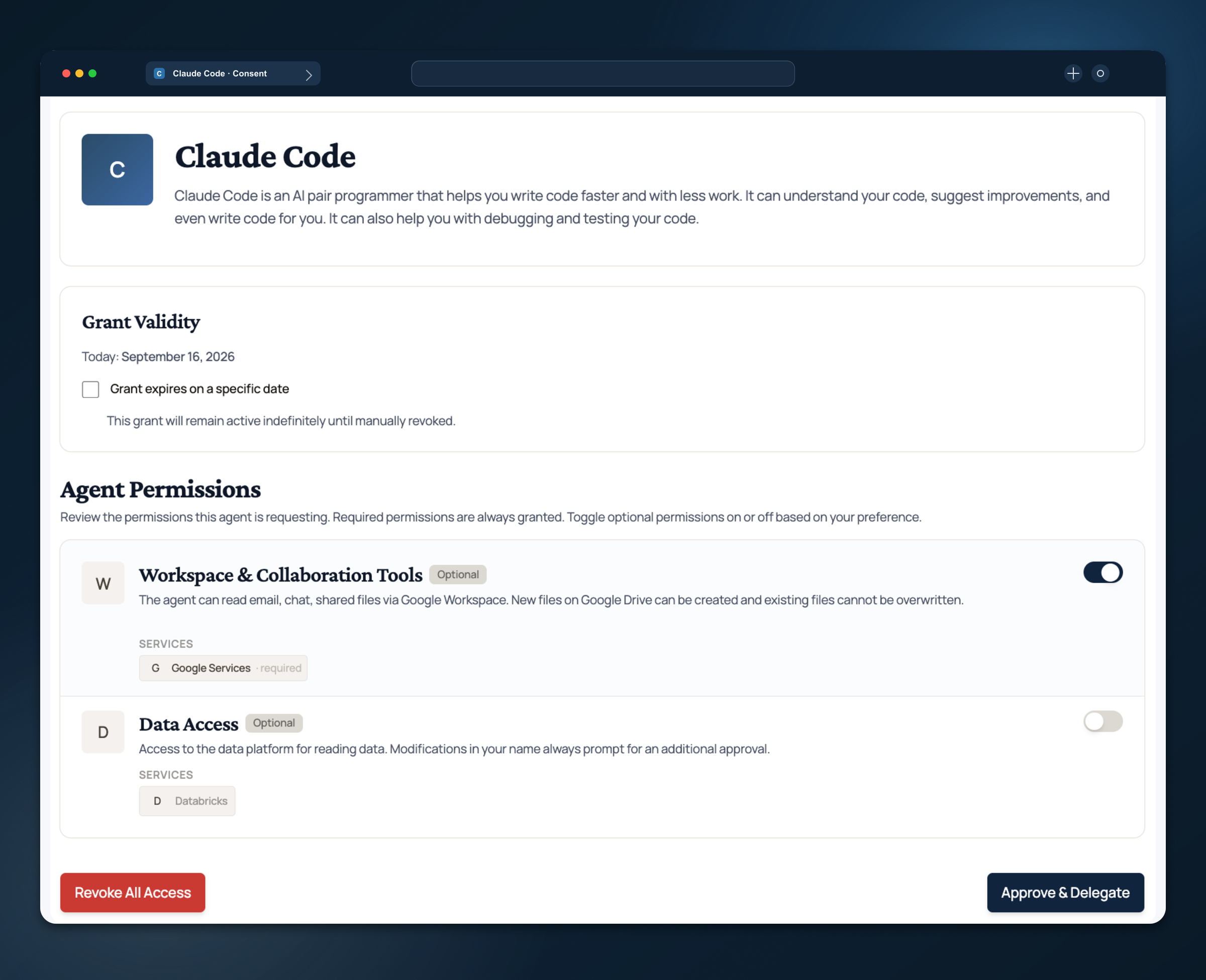
For users, the broker provides granular permission management across services including Google, GitHub, Databricks, and Linear. Its built-in consent management UI gives users a place to manage OAuth2 delegations. Consent is part of the access flow rather than something each participating tool needs to present independently.
When to use - and when NOT to
Use it when operating internal MCP servers would otherwise require configuring and maintaining OAuth2.1 ceremonies, secure token storage, and authorization servers for each server. A broker paired with a gateway centralizes that work, allowing MCP server development to focus on tools for the target technology. Agents can access hundreds of MCP servers through one channel, with token exchange handled centrally.
For SaaS providers offering MCP servers to customers, the broker adds a consent surface that records which agents were used. This supports an approval audit trail on the provider's side regardless of the customer's chosen agent interface.
Hosted agents can use a single user token across an arbitrary number of MCP servers. With a user-facing portal, token procurement can happen before the agent runs; the agent then forwards that token upstream through a gateway. This is a fit for separating user interaction from the agent's work with services.
Capabilities
Identity management covers agent registration, principal authentication, and session management. Delegation controls manage OAuth2 scopes and user consent for third-party integrations. Security measures include sensitive value redaction, command injection prevention, cryptographic validation, and a fail-closed architecture. Structured JSON logging supports compliance and security monitoring.
Impersonation supports starting delegation chains without the user being present. Privileged clients, such as a Google Chat or Slack bridge, can initiate these flows. The broker can trust two independent machine identities to assume a particular user's session, enabling use of that user's company-chat permissions in another third-party system.
Central tool approval provides a separate check before actions such as sending emails or sharing documents. Enforcement is independent of the agent interface and maintains a central audit trail. This addresses the approval step around a tool call, alongside the broker's identity and token-handling responsibilities.
Who it's for
The described deployment scenarios serve internal MCP server creators, SaaS teams exposing MCP tools to customers, and operators of hosted agents. Users participate through the consent interface, while gateway-based deployments place the broker between agents and the services they access.
Source README








Agentic Identity Broker manages delegation chains for on-behalf-of flows in Agentic AI, bridges distinct OAuth2 infrastructures, and provides a secure token vault. Deployed within the call path via gateways like Agentgateway, it offloads auth burdens from both agent and MCP server creators.
For users, it provides a simple way to manage consent, granting agents granular permissions across services such as Google, GitHub, Databricks, and Linear without compromising control.
Key Features
Secure Identity Management Agent registration, principal authentication, and session management
OAuth2 Delegation & Consent Manage OAuth2 scopes and user consent for third-party service integrations
Security-First Design Sensitive value redaction, command injection prevention, cryptographic validation, and fail-closed architecture
Rich Consent Experience Modern UX for managing OAuth2 delegations with design system compliance
Comprehensive Audit Logging Structured JSON logging for compliance and security monitoring
Use Cases
Internal MCP Servers
Frameworks like FastMCP can implement the whole OAuth2.1 ceremonies as mandated by the MCP spec but this means that you have to configure it for every MCP Server you deploy and maintain it. You also have to configure secure storage and basically run a multitude of OAuth2 authorization servers. With the identity broker and a gateway you can dumb down MCP server development to only provide tools on the target technology you want. OAuth2 ceremonies, token vaulting and token translation are done transparently. Because token exchange is done centrally via a gateway, this allows agents to interact with hundreds of MCP servers via one channel.
MCP Servers for SaaS
If you want to offer an MCP server to your customers as part of your SaaS, the identity broker can provide an additional consent surface that records which agents were actually used. With centralized tool authorization, you can keep an audit trail of approvals on your side regardless of which agent the customer runs.
Hosted Agents
The agentic identity broker can simplify agents by requiring only a single user token that can be used with an arbitrary number of MCP servers. When paired with a portal for user interactions, token procurement can be front-loaded in the portal, and the agent's responsibility is to forward this token to upstream MCP servers via a gateway.
Delegation Chains Without User Presence
The impersonation feature allows to start delegation chains via privileged clients, like a Google Chat or Slack bridge. The broker can be instructed to trust for two independent machine identities to assume the session for a particular user. This allows to use the permissions of a user on the company chat in another third-party system.
Central Authorization Prompts
The tool approval support in the broker allows to enforce tool calls independent of the agent interface in use. This allows a last resort check before emails get sent or documents shared with a central audit trail.
Documentation
Check out the following docs:
- Quickstart - Get started with Agentic Identity Broker in minutes.
- Why does this exist? - The problem, in day-to-day terms.
- agenticidentitybroker.dev - Underlying concepts, guides and API specs.
The architecture overview describes the system design, component boundaries, and domain glossary.
Agentic Identity Broker has a built-in consent management UI:
Roadmap
Agentic Identity Broker is currently in active development. We use this project in production internally for several MCP servers and have seen good potential. We are coding in the open to gauge our approach. If you find it useful, let us know. If you'd like a feature that's missing, open an issue in our GitHub repo.
While this project was created by professionals with decades of experience in the identity space (including building multiple OIDC and OAuth2 providers), it was developed with a strong focus on agentic engineering and spec-driven development. We review every PR and prioritize sound engineering practices over convenience.
Major roadmap topics include: (a) formalizing token exchange for agent-to-agent calls, (b) intent based authorization and (c) user facing acticity logs.
Discussion
Questions & comments · 0
Sign In Sign in to leave a comment.