
Route agent workflows through unified LLM gateway
Open-source gateway and router unifying hosted, BYOK, and local models behind one OpenAI-compatible API.
0.7.89Add to Favorites
Why it matters
Consolidate access to hosted, BYOK, and local language models through a single OpenAI-compatible API gateway that enforces access controls, tracks spend, and optimizes routing based on production traffic patterns.
Outcomes
What it gets done
Connect multiple LLM providers (OpenAI, Anthropic, Gemini, Azure, Bedrock) through one unified API endpoint
Control which users and agents can access specific models with budget limits and usage policies
Collect OpenTelemetry traces from production traffic to build optimized custom routers
Fine-tune open source models from captured traces to reduce cost and improve quality
Source
Get it from source
Spark does not host a copy of it.
Open sourceReports
Agent outcome reports
No reports yet
Overview
Experiential
Experiential is an open-source gateway that unifies hosted, BYOK, and local LLM providers behind one OpenAI-compatible API, with per-identity spend controls and a path to build a custom router or fine-tuned model from real traffic. Use it when multiple users or agents need centralized, budgeted access to several model providers, or when real agent traffic should be turned into a cheaper, optimized router.
What it does
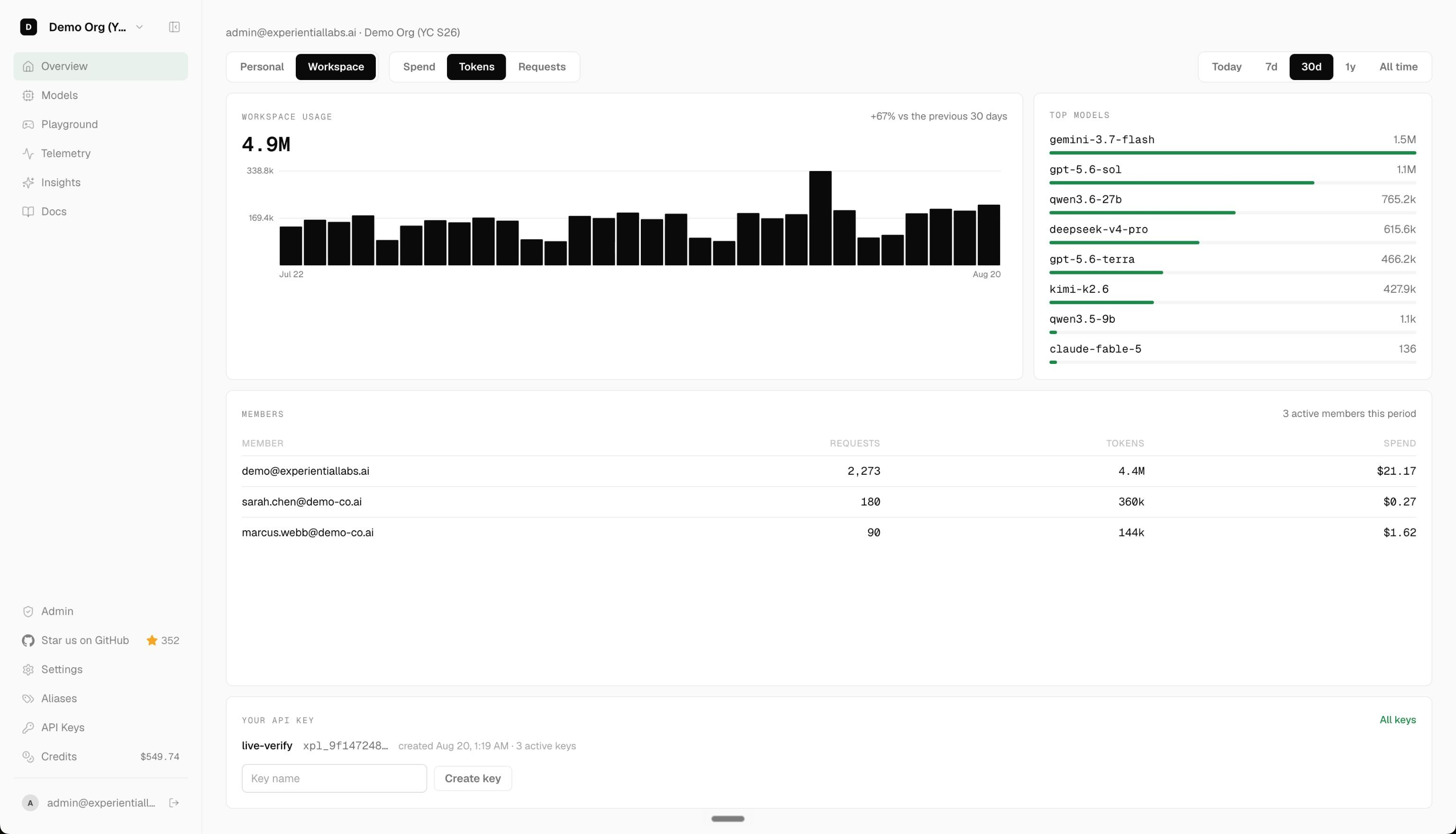
Experiential is an open-source gateway and router for agent workflows. It lets you use hosted, bring-your-own-key, and local models through one OpenAI-compatible API, control which users and agents can use which models for which use cases and how much they can spend, and turn production traffic into a custom router or fine-tuned model optimized for quality, speed, and cost. Running exp starts a local gateway; a setup wizard walks through provider, model, and reasoning-effort selection, persists each provider connection, sets a default public alias, identity, and a $50.00 command budget, then issues a one-time API key. From Python, a fitted project router can be loaded as an official OpenAI client backed by its own private gateway.
When to use - and when NOT to
Use Experiential when multiple users, agents, or coding tools need centralized access to several model providers with per-identity spend controls, or when you have real agent traffic and want to compile it into a router or a fine-tuned open-source model instead of continuing to call a general-purpose model directly. It also fits repointing existing coding agents (Claude Code, Cursor, Codex, Aider) at one gateway for consistent key management and budgeting. It has both a self-hosted local mode and a hosted platform at platform.experientiallabs.ai serving the same OpenAI-compatible and Anthropic Messages API - choose local for full control over data and infrastructure, or hosted for a managed setup that a coding agent can configure for you via copy-paste prompts.
Inputs and outputs
pip install experiential
exp
After setup, send a request with the issued key:
export EXP_GATEWAY_KEY=...
curl http://127.0.0.1:8000/v1/chat/completions \
  -H "Authorization: Bearer $EXP_GATEWAY_KEY" \
  -H 'Content-Type: application/json' \
  -d '{"model":"opus-5","messages":[{"role":"user","content":"Help me"}]}'
To optimize from real traffic: collect OpenTelemetry traces from an existing agent (or use the public terminal-tasks OTLP dataset for a trial run), then exp build support-agent walks through providers, models, and budget and asks for the trace file to build a simulation and optimize a router against it. exp optimize model support-agent fine-tunes an open-source model the user owns using Tinker, after traces have been collected from the router.
Integrations
BYOK connections cover OpenAI, Anthropic, Gemini, Azure, Bedrock, Fireworks, and OpenRouter, passed through for free. Anonymous aggregate PostHog product telemetry is enabled by default and never includes prompts, traces, actions, observations, paths, model names, credentials, or raw customer content; it can be checked or toggled with exp config telemetry status, disable, or enable, with the preference stored locally in .exp/settings.toml.
Who it's for
Teams running multiple AI coding agents or products against several model providers who need centralized access control, per-identity spend budgets, and a path to turning real traffic into a cheaper, faster custom router or fine-tuned model.
Source README
Experiential

Experiential is an open source gateway and router for agent workflows:
- Use hosted, BYOK, and local models through one OpenAI-compatible API.
- Control which users and agents can use which models, for which use cases, and how much they can spend.
- Turn production traffic into a custom router or model optimized for quality, speed, and cost.
 Discord
Getting Started
Start a local OpenAI-compatible gateway. On first run, the setup wizard uses the shared provider,
model, and reasoning-effort selectors, persists every selected provider connection, then shows
defaults for the public alias, identity, and $50.00 command budget before printing a one-time key:
pip install experiential
exp
Choose a public alias such as opus-5, capture the issued key, and send a request:
export EXP_GATEWAY_KEY=...
curl http://127.0.0.1:8000/v1/chat/completions \
  -H "Authorization: Bearer $EXP_GATEWAY_KEY" \
  -H 'Content-Type: application/json' \
  -d '{"model":"opus-5","messages":[{"role":"user","content":"Help me"}]}'
Setup / get started with the hosted gateway
Prefer a managed gateway to running one locally? The hosted platform at
platform.experientiallabs.ai serves the same
OpenAI-compatible (and Anthropic Messages) API at https://api.experientiallabs.ai/v1.
See SETUP.md for copy-paste prompts you hand to your coding agent
(Claude Code, Cursor, Codex, and similar); the agent runs the setup for you. It
collects four prompts:
- Upload your LLM traces as telemetry: create an account instantly from your email, then pull or upload your existing LLM traces onto the platform as telemetry.
- Connect your inference provider keys (BYOK): create an account, then connect your own OpenAI, Anthropic, Gemini, Azure, Bedrock, Fireworks, or OpenRouter keys for free pass-through.
- Start calling models on the gateway: make your first
/v1call with the OpenAI and Anthropic SDKs using anxpl_key, and optionally repoint your existing coding agents. - Full onboarding: create an account instantly from your email, connect your keys, import your spend, then repoint every coding agent (Claude Code, Cursor, Codex, Aider, and similar) or Conductor at the gateway.
Using the API
Start the local gateway with exp (or exp run); the compiled native data plane
serves every route on loopback. From Python, load a fitted project router as an
official OpenAI client backed by its own private gateway:
import exp

with exp.load_router("my-project") as client:
    response = client.chat.completions.create(
        model="my-project",
        messages=[{"role": "user", "content": "hello"}],
    )
Optimize from Traffic
First, collect OpenTelemetry traces from your current agent. If you just want to try it out, grab
the public terminal-tasks OTLP dataset:
curl -L -o traces.otel.jsonl \
  https://huggingface.co/datasets/experiential-labs/wmo-terminal-tasks-traces/resolve/540883e451dc13d34fb50fdd36b143cb0f1fb0db/traces.otel.jsonl
Then build a project. The build command walks you through providers,
models, and budget, and asks for your trace file:
# Build simulation from your agent traces and optimize a router against it
exp build support-agent
After collecting traces from your router, fine-tune an open source model you own using
Tinker.
exp optimize model support-agent
Telemetry
Anonymous aggregate PostHog product telemetry is enabled by default. It never includes prompts,
traces, actions, observations, paths, model names, credentials, or raw customer content.
exp config telemetry status
exp config telemetry disable
exp config telemetry enable
The preference is stored locally in .exp/settings.toml.
Development
uv sync --extra dev
uv run ruff format --check .
uv run ruff check .
uv run ty check
uv run pytest -q
Repository and documentation conventions live in AGENTS.md.
FAQ
Common questions
Discussion
Questions & comments · 0
Sign In Sign in to leave a comment.