
Pre-register technical decisions with expert AI personas
ask-the-board runs a board of AI personas whose decisions are pre-registered, dated predictions graded against reality later.
0.2.5Add to Favorites
Why it matters
Create a timestamped, reality-graded record of technical decisions by convening a board of AI expert personas who each stake probabilistic predictions before outcomes are known, then automatically score their calibration against actual results.
Outcomes
What it gets done
Convene a board of AI expert personas to debate architecture and library choices with dissenting viewpoints
Pre-register falsifiable predictions with resolution dates and probability estimates anchored in git history
Automatically resolve predictions against real outcomes and compute Brier scores for each expert seat
Generate committable ADRs (Architecture Decision Records) with full audit trails of who predicted what
Source
Get it from source
Spark does not host a copy of it.
Open sourceReports
Agent outcome reports
No reports yet
Overview
Asktheboard
ask-the-board is a CLI and library that runs a board of AI personas whose decisions become pre-registered, dated, falsifiable predictions rather than one-off chat answers. Each prediction is graded against reality on its resolution date and scored per persona by Brier calibration, with the record committed to git as a timestamped ADR. Use it to force a real technical or business decision through a documented prediction that gets checked against reality later. Not a fit for a quick multi-persona debate with no follow-through, since grading only happens on the resolution date.
What it does
ask-the-board is a CLI and Python library that runs a "board" of expert personas whose every decision is a pre-registered, time-anchored, falsifiable bet rather than a one-off chat answer. For each decision it records a stated prior, a per-seat dissent vector (each persona's stance and its own probability), and a dated prediction anchored before the outcome is knowable; on the resolution date, the realized outcome is reconciled into a Brier calibration score per seat. Each decision is written as a git-committable ADR, so the git commit timestamp is the external attestation that the prediction really was made before the fact - a record that is hard to fake because you can buy model outputs but you cannot back-date a commit.
When to use - and when NOT to
Use it to force a real decision - adopting a dependency, migrating a datastore, committing to an architecture - through a documented, falsifiable prediction that will actually be checked against reality later, building an accumulating calibration record for the personas or the team making the calls. It is not a fit if you want a quick debate-style multi-persona chatbot with no follow-through - the entire point is the reality check on a fixed date, and a minute cannot be graded before its resolution date arrives, by design. The create -> resolve -> score mechanism itself needs no LLM, key, or network; only convene, which generates a fresh board-minute from live model calls, needs one.
Inputs and outputs
asktheboard create --spec <file.json> pre-registers a hand-written minute (question, prior, decision, a falsifiable prediction with a resolution date, and each seat's stance, probability, and rationale), writing both a JSON record and a Markdown ADR into board-minutes/. asktheboard resolve --id <id> --outcome <true|false> grades it against reality once the date arrives, and asktheboard score prints each seat's sample count, mean Brier score, wins, and losses, best-calibrated first. asktheboard convene instead generates the minute itself: every seat answers through your own LLM key, and the board's consensus probability is the mean of the seats' calls; decision_type (library, migration, architecture) sets a default resolution horizon of 90, 180, or 365 days, overridable with an explicit resolution_date.
Integrations
The engine ships no LLM provider and makes no calls of its own - convene speaks through HTTPLLMClient, a stdlib-only, zero-dependency client that works with any OpenAI-compatible endpoint, such as OpenRouter, Together, or a local server, via --base-url, reading a key such as OPENAI_API_KEY. A default roster of role archetypes - architect, skeptic, pragmatist, researcher, operator, strategist - ships in the box as named seats and panels (tech, decision, ops, default); the skeptic sits on every panel by design, since a board with no dissent keeps no honest score. A managed, capped hosted tier with a public scoreboard is planned but not yet available. It is MIT-licensed; the public API is still 0.x and may change before 1.0.
asktheboard create  --spec sample_minute.json
asktheboard resolve --id 2026-01-postgres-vs-vectordb --outcome true
asktheboard score
Who it's for
Teams and individuals who want their technical or business calls to accumulate an honest, tamper-resistant track record - pip-installable, BYOK, and free to run at any scale for anyone willing to wait out the resolution date.
Source README
ask-the-board


A board of expert personas whose every decision is a pre-registered,
time-anchored, reality-graded bet. Not a chatbot that agrees with you -- a board
that keeps score, before the fact.
Landing page & docs: https://danilushin.github.io/asktheboard/
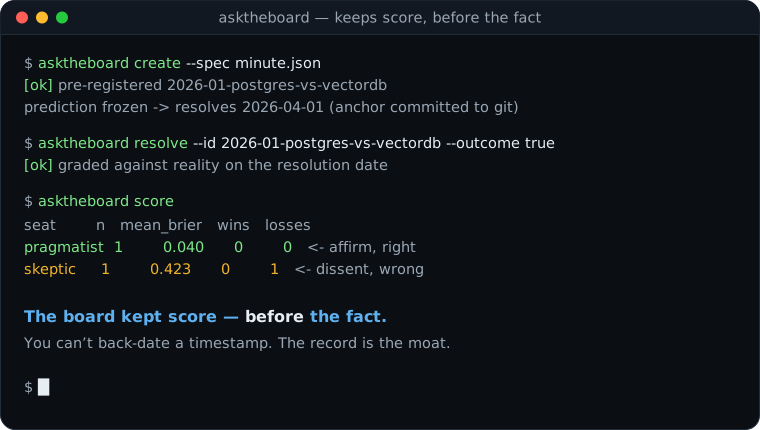
Mechanism on sample data - the 60-second, no-key walkthrough below reproduces it exactly.
pip install asktheboard
Why this exists
Anyone can clone a "panel of AI personas" in a weekend, and a dozen have. The
debate mechanic is a commodity. What it leaves out is the thing that makes advice
worth trusting: a record of having been right before the outcome was knowable.
That record is hard to fake -- you can buy model outputs, but you can't
back-date a timestamp. It only accrues the slow way: by calling decisions in
advance and letting reality grade them, one resolution date at a time.
So ask-the-board records, for every decision:
- your stated prior (what you believed going in),
- the per-seat dissent vector -- each seat's stance + its own probability,
- a dated, falsifiable prediction, anchored before the outcome is knowable,
- on the resolution date, reality's realized outcome, auto-reconciled into a
Brier/calibration score per seat.
The board-minute is a git-committable ADR. Your git history is the external
attestation of the anchor timestamp. The accumulating, reality-graded record is
the durable asset.
See it keep score (60s, no API key)
create -> resolve -> score is pure data -- no LLM, no key, no network. This is a
worked example on sample data: you supply the outcome with resolve, and the
engine computes each seat's Brier score (lower is better). It shows the mechanism,
not a track record -- the integrity comes from the anchor timestamp your git history
attests, which no demo can fabricate. The committed artifacts live inexamples/.
# pip-installed (no repo)? paste the sample spec below. Cloned the repo?
# skip the heredoc and use --spec tests/sample_minute.json instead.
cat > sample_minute.json <<'JSON'
{
  "id": "2026-01-postgres-vs-vectordb",
  "question": "Adopt Postgres + pgvector, or a dedicated vector DB?",
  "prior": "Leaning toward a dedicated vector DB for the embeddings workload.",
  "decision": "Stay on Postgres + pgvector for now.",
  "prediction": {
    "statement": "We will NOT migrate off Postgres for vectors within 3 months.",
    "resolution_date": "2026-04-01",
    "board_probability": 0.75
  },
  "seats": [
    {"seat": "pragmatist", "stance": "affirm", "probability": 0.8, "rationale": "Boring tech; pgvector is enough at this scale."},
    {"seat": "skeptic", "stance": "dissent", "probability": 0.35, "rationale": "Recall/latency will bite once the corpus 10x's."}
  ],
  "created_at": "2026-01-05T10:30:00"
}
JSON

asktheboard create  --spec sample_minute.json
asktheboard resolve --id 2026-01-postgres-vs-vectordb --outcome true
asktheboard score
seat               n  mean_brier  wins  losses
----------------------------------------------
pragmatist         1       0.040     0       0
skeptic            1       0.423     0       1
Full walkthrough + committed artifacts: examples/README.md.
And a real one, still open: this repo pre-registered a board-minute about its own
launch -- examples/open-minute.md, anchored in git on
2026-06-26, resolving 2026-09-24. No score yet; that's the point. The board may turn
out wrong, and the anchor means it can't pretend otherwise.
Live bet #1 (resolves in days): the board's call on the June 2026 US jobs report
-- examples/2026-06-jobs-report.md,
anchored 2026-06-27, resolving 2026-07-02 against the BLS Employment Situation
release. The board says +150k or more at 56%; the skeptic dissents at 40%. Bet #1 of
a public, recurring cadence -- come back on the date and watch it grade against a source
nobody controls.
BYOK (bring your own API key)
The engine ships no provider and makes no calls of its own. You supply your own
LLM key; you pay your own inference. The open-source core therefore costs nothing
to run at any scale -- the cost lives with the user, not a host. (A managed,
capped hosted tier -- for people who would rather not manage keys -- is the
separate, paid product.)
Hosted tier -- join the waitlist
The OSS engine is free forever and runs on your own key. If you'd rather not
manage keys -- or you want the aged, reality-graded public scoreboard hosted
for you -- a managed, capped paid tier is coming.
Want early access? Email support@chu6a.dev with the subject waitlist
(a one-liner on what you'd decide with it helps, but isn't required). No spam --
one note when it opens.
Integrity guarantees (enforced in code)
- A prediction cannot be pre-registered to resolve in the past (no backfilling
an "old" call onto a known outcome). - A minute cannot be graded before its resolution date -- the outcome must not
be knowable yet. That is what makes it foresight. - The anchor timestamp and the prediction are frozen once created; grading
never moves them.
See tests/test_model.py -- these are the load-bearing tests.
Quick start
pip install asktheboard

# pre-register a decision (board-minute spec is JSON -- see "See it keep score" above)
asktheboard create  --spec sample_minute.json

# ... months later, on/after the resolution date, grade it against reality
asktheboard resolve --id 2026-01-postgres-vs-vectordb --outcome false

# per-seat calibration scoreboard, best-calibrated first
asktheboard score
create writes both <id>.json (the record) and <id>.md (the committable ADR)
into board-minutes/.
Convene a board (BYOK)
create pre-registers a minute you wrote by hand. convene runs the live LLM
fan-out: every seat answers through your key, and the board's consensus
probability is the mean of the seats' calls. It ships no provider -- bring an
OpenAI-compatible endpoint (HTTPLLMClient is stdlib-only, zero dependencies).
from asktheboard import convene, Seat, HTTPLLMClient

minute = convene(
    id="pgvector-scale",
    question="Will pgvector hold our scale, or do we need a dedicated vector DB?",
    prior="leaning postgres to avoid a new service",
    decision="stay on postgres + pgvector",
    statement="pgvector serves p95<150ms at 50M embeddings without a dedicated DB",
    seats=[Seat("pragmatist", "ML researcher"), Seat("skeptic", "find the failure mode")],
    client=HTTPLLMClient(model="gpt-4o-mini"),   # reads OPENAI_API_KEY
    decision_type="library",                     # -> 90-day resolution horizon
)
Or from the CLI (key in OPENAI_API_KEY):
asktheboard convene --spec convene.json --model gpt-4o-mini
Any OpenAI-compatible API works -- point --base-url (or HTTPLLMClient(base_url=...))
at OpenRouter, Together, or a local server. The engine still makes no calls of its
own; it only ever speaks through the client you pass.
Bundled roster -- seat a board by name
You can always hand-write Seat(name, persona). But a sensible default board ships
in the box: a curated set of role archetypes (the architect, the skeptic, the
operator -- functions, not impersonations of real people) and a few named panels,
so seating one is a single lookup.
from asktheboard import convene, panel, seats, HTTPLLMClient

minute = convene(
    id="pgvector-scale",
    question="Will pgvector hold our scale, or do we need a dedicated vector DB?",
    prior="leaning postgres",
    decision="stay on postgres + pgvector",
    statement="pgvector serves p95<150ms at 50M embeddings without a dedicated DB",
    seats=panel("tech"),                  # architect + skeptic + pragmatist
    # seats=seats(["architect", "operator", "skeptic"]),   # or pick your own
    client=HTTPLLMClient(model="gpt-4o-mini"),
    decision_type="library",
)
From the CLI, pass --panel or --seats instead of putting seats in the spec:
asktheboard roster                                   # list seats + panels
asktheboard convene --spec d.json --model gpt-4o-mini --panel tech
asktheboard convene --spec d.json --model gpt-4o-mini --seats architect,skeptic
| seat | voice |
|---|---|
architect |
shape, maintenance cost, what breaks at scale, build-vs-buy |
skeptic |
forced dissent -- the most likely failure first, then the deeper objection |
pragmatist |
simplest thing that ships; YAGNI; opportunity cost |
researcher |
what the data actually says; base rate before anecdote |
operator |
run cost, failure budget, who gets paged at 3am |
strategist |
base rates, second-order effects, one-way vs reversible doors |
Panels: tech (architect/skeptic/pragmatist), decision (strategist/skeptic/researcher),ops (operator/architect/skeptic), default (architect/skeptic/pragmatist/strategist).skeptic sits on every panel by design -- a board with no dissent keeps no honest score.
Decision types -> default horizons
A minute is only foresight if it has a date by which reality can grade it.decision_type picks a sensible default horizon so the common case is one lookup
(and a 5-year horizon on a library swap stands out as dishonest):
| type | horizon | when |
|---|---|---|
library |
90d | adopt/swap/drop a dependency |
migration |
180d | move a datastore, platform, or pipeline |
architecture |
365d | a structural design bet you live with |
Short-latency first on purpose: a fresh board earns a track record on fast library
calls before anyone trusts its slow architecture bets. Pass an explicitresolution_date= to override.
A contrarian win
When a seat dissents from the board and turns out more right than the
consensus, that is a contrarian win -- the gold the public scoreboard is built
from. The board changed (or should have changed) its mind, and reality later
stamped the dissenter vindicated.
Stability
What's shipped: the foresight engine (data model + grading + committable
ADR) and the BYOK LLM fan-out that produces a board-minute
(asktheboard.convene, behind the asktheboard.llm Protocol). No provider is
bundled -- you plug in your own key.
The public API is 0.x / unstable. The LLMClient / HTTPLLMClient surface
and the board-minute JSON schema may change before 1.0 -- pin a version if you
depend on them.
Built with
Built by Dan Ilushin with Claude (Anthropic) in
the loop. Contributions welcome -- see CONTRIBUTING.md
(DCO sign-off) and SECURITY.md.
FAQ
Common questions
Discussion
Questions & comments · 0
Sign In Sign in to leave a comment.